All published articles of this journal are available on ScienceDirect.

Comparative Effects of Magnetic Field, Hydropriming, and GA3 Seed Priming in Safflower (Carthamus tinctorius L.)

Abstract
Introduction
Seed priming is widely used to improve crop establishment, but there are limited field studies that compare different priming methods considering plant growth throughout the season. This study compares physical and chemical seed priming methods in safflower under field conditions and evaluates their effects on growth and yield.
Methods
A randomized complete block design was conducted with four treatments (Magnetic Field (MF), Hydropriming (HP), Gibberellic Acid (GA3), and control) and five replications. Plant growth was assessed using parameters related to canopy development, biomass accumulation, and photosynthetic efficiency. Data were analyzed using Analysis of Variance (ANOVA), and treatment effects were considered significant at P < 0.05 and P < 0.01.
Results
Seed priming significantly improved growth and yield compared with the control (P < 0.01). Magnetic field priming resulted in the highest canopy development, with a maximum leaf area index of 3.72 and leaf area duration of 1794. Seed yield reached 4007 kg ha−1, representing a 199% increase over the control (1338 kg ha−1), and exceeding GA3 and HP treatments by 32% and 62%, respectively. GA3 mainly improved early photosynthetic efficiency, whereas HP enhanced initial seedling vigor.
Discussion
In contrast, MF priming promoted sustained canopy development and biomass accumulation throughout the growth cycle.
Conclusion
Treatments supporting longer canopy activity were more effective for improving safflower yield than those primarily affecting early growth stages. Magnetic field priming improved safflower growth and yield and may serve as a useful non-chemical seed treatment approach. Further studies are needed to confirm these responses under different environmental conditions.
1. INTRODUCTION
Ensuring global food security while maintaining environmental sustainability is one of the most critical challenges facing modern agriculture. Climate change, increasing population pressure, and degradation of natural resources continue to affect crop productivity and yield stability in many agricultural regions. With the global population projected to reach 9.7 billion by 2050, agricultural production must increase by approximately 60% to meet future food demands [1-3]. However, climate-induced stresses such as drought, heat waves, and soil degradation continue to threaten crop productivity and yield stability [2]. For this reason, improving crop establishment and early plant growth has become increasingly important in sustainable agriculture. As a result, considerable attention has been given to agronomic practices that can improve productivity while reducing dependence on chemical inputs.
Sustainable agriculture must be understood as a complex and interconnected system that extends beyond reducing chemical inputs and should also be considered within the broader framework of global food systems. Agricultural systems are expected to increase production while using resources more efficiently and reducing environmental impacts. This requires integrated management approaches that consider the interactions between crop and livestock production systems. Livestock and crop production are tightly connected, and ruminants play an important role in converting non-edible biomass into valuable nutrients while supporting food security and rural livelihoods [4]. Interactions such as feed–food competition and shared resource use influence land-use efficiency, nutrient cycling, and overall system sustainability [5, 6]. Thus, improving crop productivity contributes not only to food availability but also to more efficient resource utilization across agricultural systems. Moreover, improving agricultural sustainability also involves reducing greenhouse gas emissions and increasing production efficiency. However, some management strategies may involve trade-offs related to productivity, ecosystem impacts, and long-term sustainability [6-8].
To address these challenges, sustainable agricultural strategies increasingly aim to reduce competition between food and feed resources and improve the efficiency of biomass utilization, promoting the use of alternative inputs and technologies that minimize environmental impact while maintaining productivity [9]. Among these, seed treatment technologies are considered useful approaches for improving plant vigor and early establishment by stimulating physiological processes prior to germination [10-12].
Seed treatment involves the application of chemical, biological, or physical agents to seeds before sowing to improve germination, seedling vigor, and tolerance to biotic and abiotic stresses. Although high-quality seeds are fundamental for achieving optimal crop productivity, seed deterioration, pathogen infection, and environmental stresses often limit germination efficiency and early plant development. Seed treatments have been shown to reduce oxidative damage, enhance antioxidant defense systems, and improve tolerance to stresses such as drought, salinity, and deep sowing conditions [13-15].
At the same time, increasing attention has been given to the use of alternative biomass and agro-industrial byproducts as sustainable inputs. The use of these resources can improve nutrient cycling, reduce agricultural waste, and improve system efficiency [16]. Such practices may also strengthen the link between crop and feed systems through optimized nutrient flows. These integrated approaches contribute to the development of more resilient and efficient agricultural systems [17-19].
Seed priming techniques can be broadly categorized into conventional and advanced approaches. Conventional methods, including hydropriming, osmopriming, hormone priming, nutritional priming, and biopriming, are widely used due to their simplicity and effectiveness in enhancing germination and seedling vigor [20]. For instance, hormone priming with plant growth regulators such as Gibberellic Acid (GA3), salicylic acid, and melatonin has been shown to stimulate enzymatic activity and improve stress tolerance [21]. Hydropriming, one of the simplest and most cost-effective techniques, is particularly beneficial under drought conditions [22]. These methods have shown positive effects on germination and early growth, including in safflower under hydropriming and magnetic treatments [23, 24].
Despite their effectiveness, chemical treatments may pose environmental and health risks when overused. As a result, research has also focused on environmentally friendly alternatives, particularly physical seed treatments such as ultraviolet radiation, laser irradiation, cold plasma, electromagnetic fields, and magnetic fields [25, 26]. These techniques enhance germination and plant growth without introducing chemical residues into the environment.
Among these, the Magnetic Field (MF) treatment has received increasing attention. Exposure to static MF has been reported to enhance germination, root and shoot growth, chlorophyll synthesis, and overall plant productivity [27, 28]. Magnetic field priming may influence cellular metabolism by affecting ion transport, enzyme activity, and membrane permeability, which may contribute to improving early growth and stress tolerance [29]. Proposed mechanisms include ion cyclotron resonance, radical pair interactions, and cryptochrome-mediated signaling pathways [27].
Seed priming has been widely reported to improve germination and early growth in safflower and other crops. For example, Faqenabi et al. (2009) [24] demonstrated enhanced germination and yield traits following magnetic and hydropriming treatments, while similar improvements have been reported in other studies [23]. Recent research has highlighted the broader role of priming in enhancing germination, growth, and stress tolerance in different crop species [30]. However, most studies focus primarily on early-stage responses, with limited evaluation of growth dynamics and yield formation under field conditions. Thus, comprehensive field-based assessments integrating physiological growth analysis remain scarce.
Safflower (Carthamus tinctorius L.), a member of the Asteraceae family, is an important oilseed crop valued for its high-quality edible oil and industrial applications. It is well adapted to semi-arid environments and exhibits tolerance to drought and salinity, making it suitable for water-limited regions [31]. Its seeds contain 25–45% oil, rich in unsaturated fatty acids such as oleic and linoleic acids [32]. Beyond food uses, safflower oil is used in cosmetics, pharmaceuticals, paints, and biofuel production, while its pigments (carthamin, a red pigment, and carthamidin, a yellow pigment) are used as natural dyes [27, 33].
Safflower is cultivated in over 20 countries, with major producers including India, Kazakhstan, the United States, Mexico, and Turkey, and global production approaching one million tons annually [34]. However, its productivity is still relatively low because of poor seed vigor, environmental stress, and suboptimal crop establishment.
A major constraint in safflower production is rapid seed deterioration during storage, largely due to high oil content, which promotes lipid peroxidation and oxidative damage. This reduces germination capacity and overall crop establishment [35]. Seed priming has been investigated as an approach to reduce these problems by activating metabolic processes, enhancing antioxidant defenses, and improving early plant growth [36].
Despite growing interest in seed priming, comparative studies evaluating the effects of biochemical and biophysical methods on safflower growth dynamics are limited. There is a lack of field-based studies that compare different priming approaches while integrating physiological growth analysis with yield formation. Improving productivity while reducing environmental impact requires optimizing nutrient utilization and system efficiency, which is important in both crop and livestock systems, where improved digestibility and resource use can contribute to sustainability outcomes [37].
Therefore, this study aimed to evaluate the effects of hydropriming, gibberellic acid treatment, and magnetic field exposure on physiological growth indices and yield performance of safflower under field conditions. The study combines crop growth analysis with yield evaluation to better understand how different priming treatments influence safflower growth and productivity under field conditions.
2. MATERIALS AND METHODS
2.1. Experimental Site and Seed Preparation
The experiment was conducted using the safflower cultivar IL111 were obtained from PAKAN BAZR company (Iran), with seed treatments applied before sowing and plant growth evaluated under field conditions. The experimental field is located at Urmia, Iran, which has a mountainous climate characterized by cold winters and warm summers. The mean annual temperature is approximately 11.6°C, with average daily temperatures ranging from about −6°C in winter to 31°C during the peak summer months. During the cropping period (spring to summer), temperatures gradually increased from approximately 10–15°C at early growth stages to 25–31°C during the reproductive phase. The mean annual precipitation is approximately 300–350 mm, with most rainfall occurring during late winter and spring, particularly in April. In contrast, summer months receive very limited rainfall, with August being the driest period. Therefore, rainfall during the later growth stages was minimal, and crop development occurred under relatively dry conditions. Overall, the growing season was characterized by moderate temperatures during early stages, followed by warm and dry conditions during reproductive growth, with no severe abiotic stress such as extreme heat or prolonged drought observed during the experimental period. The soil of the experimental field was clay soil with non-saline conditions (EC = 0.36 dS m−1) and a pH of 7.9 The soil was low in available nitrogen (220.36 kg ha−1), medium in available phosphorus (50.74 kg ha−1), and high in available potassium (470.14 kg ha−1). Seeds with uniform size and high viability were selected prior to treatment. The field experiment was conducted under standard agronomic practices following soil preparation and fertilization based on soil test recommendations.
A flowchart of the experiment procedure is provided in Fig. (1).
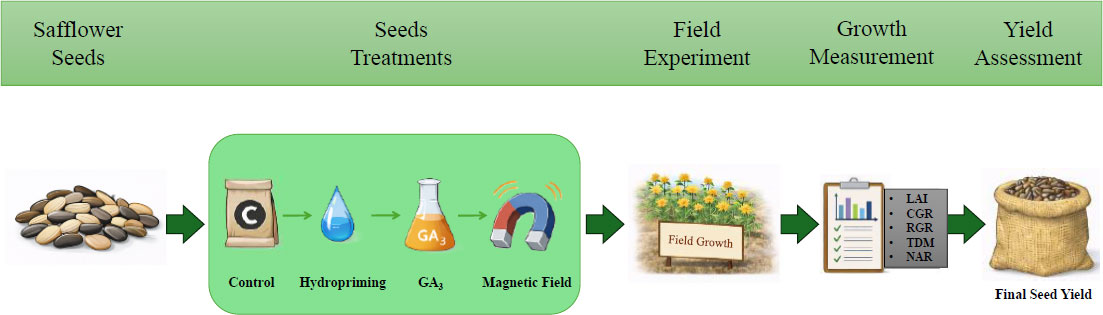
Flowchart of the experimental design illustrating the effects of seed priming treatments, Magnetic Field (MF), Gibberellic Acid (GA3), Hydropriming (HP), and control, on physiological growth parameters, canopy development, and final seed yield of safflower, highlighting the sequence of treatments and their role in evaluating growth dynamics and yield formation.
Seed priming treatments were applied prior to sowing:
- Hydropriming (HP): Seeds were placed in an environment with 100% relative humidity at 20 ± 2°C for 72 h. After priming, seeds were air-dried to their original moisture content before planting.
- Gibberellic Acid (GA3): Seeds were soaked in a 50-ppm solution of Gibberellic Acid (GA3) (Sigma-Aldrich, USA) for 8 h. Following treatment, seeds were removed, rinsed lightly, and dried at room temperature.
- Magnetic Field (MF): Seeds were first soaked in water for 5 h and surface-dried with paper towels. They were then exposed to a static horizontal magnetic field strength of 72 mT with a gap of 5 cm between pole pieces for 10 min using a cylindrical sample holder connected to an electromagnetic field generator EM‐20 at room temperature.
- Control (C): Untreated seeds were used as the control group.
The experiment was arranged in a Randomized Complete Block Design (RCBD) with five replications, and the field was prepared by one deep ploughing with a tractor-drawn plough followed by harrowing and leveling to obtain a loose and friable seedbed on 2 May. The use of five replications was intended to account for spatial variability within the field and to improve the precision and reliability of treatment comparisons, while providing adequate experimental precision for detecting treatment effects under field conditions, which is consistent with standard agronomic field practices.
After final leveling, plots and irrigation channels were prepared. The experimental field was divided into plots measuring 3 × 5 m. Based on the plot size and plant spacing of 45 × 15 cm, each plot contained approximately 222 plants. Standard crop management practices were applied throughout the growing season. The recommended dose of phosphorus (P2O5) was applied at 30 kg ha−1 as a basal application. Nitrogen fertilizer was applied in two equal splits, with 50% applied at sowing and the remaining 50% applied 30 days after sowing. The experiment was conducted under furrow irrigation, and irrigation was applied as required throughout the growing season to avoid severe water limitation and maintain normal crop growth. Weeds were controlled manually as required during the growing season to minimize competition with the crop. No major pest or disease infestations were observed during the experiment, and no pesticide applications were required.
At physiological maturity, plants were harvested manually from the central rows of each plot to avoid border effects. Whole plants were collected and subsequently separated into their respective components for yield and growth measurements.
Part of the yield component data, including number of heads per plant, seeds per head, 1000-seed weight (g), and seed yield (kg ha−1), presented in Tables 1 and 2, has been previously published by authors [24]. In the present study, these data were reanalyzed and integrated with additional physiological growth indices to provide a more comprehensive evaluation of seed priming effects under field conditions.
| SOV | DF | Head | Seed/Head | 1000 Seed Weight (g) | Seed yield (kg ha-1) | LAImax | LAD |
|---|---|---|---|---|---|---|---|
| Block | 4 | 2.163 | 13.878 | 18.223 | 179891.88 | 0.666 | 2818.86 |
| Treatment | 3 | 39.842** | 313.593** | 202.586** | 6199458.317** | 2.437** | 494874.68** |
| Error | 12 | 1.507 | 16.695 | 24.012 | 116319.026 | 0.346 | 2323.60 |
Note: Data adapted from Faqenabi et al. (2009) [24].
(ns: non-significant, * P < 0.05, ** P < 0.01).
| Treatment | Head | Seed/Head | 1000 Seed Weight (g) | Seed yield (kg ha-1) | LAImax | LAD |
|---|---|---|---|---|---|---|
| Magnetic field | 13.19 a | 42.4 a | 59.93 a | 4007 a | 3.72a | 1794 a |
| Hydro-priming | 9.134 b | 35.08 b | 50.7 b | 2479 c | 3.398 ab | 1114 c |
| Gibberellic | 9.11 b | 36.89 ab | 46.72 b | 3028 b | 2.664 bc | 1407 b |
| control | 6.34 b | 23.56 c | 46.17 b | 1338 d | 2.174 c | 1145 c |
Note: Data adapted from Faqenabi et al. (2009) [24].
2.2. Growth Analysis and Data Collection
Physiological growth indices were calculated using standard crop growth analysis methods based on periodic measurements of leaf area and plant dry matter during the growing season. Plant growth and development were monitored throughout the growing season. Plants were sampled at 7-day intervals across 8 sampling dates, covering the main vegetative and reproductive growth stages. At each sampling date, three representative plants were collected from the central area of each plot while avoiding border plants. Leaf area was measured using Flächenberechnung einer Grafik graphical software (A. Kraf Software, 1995).
The following growth indices were calculated:
- Crop Growth Rate (CGR) is defined as the increase in plant tissue per unit of time
- Relative Growth Rate (RGR), expressed as the increase in plant tissue per unit plant tissue present per unit of time
- Net Assimilation Rate (NAR), used as an indicator of photosynthetic efficiency
- Leaf Area Index (LAI), defined as leaf area per unit ground area
- Leaf Area Ratio (LAR), representing the proportion of aboveground dry matter partitioned into leaf area
- Leaf Area Duration (LAD)
- Total Dry Matter (TDM)
These growth indices were selected because they provide complementary insights into plant growth dynamics and productivity. Parameters such as LAI and LAD describe canopy development and duration of photosynthetically active leaf area, which are directly related to light interception and biomass production. CGR and RGR reflect the rate of biomass accumulation, while NAR indicates photosynthetic efficiency per unit leaf area. Together, these indices are widely used to explain variations in dry matter production and their contribution to final yield formation under field conditions [38].
Physiological growth indices were calculated according to standard crop growth analysis procedures based on periodic measurements of leaf area and plant dry matter during the growing season [38].
The following equations for CGR, RGR, NAR, LAI, LAD, and LAR were adapted from standard crop growth analysis methods described by Hunt [38] and are presented in Eqs. (1-6):
CGR (g cm-2 GDD-1) = (W2 - W1) / ((T2 – T1) × A)...(1)
RGR (g g-1 GDD-1) = (ln W2 – ln W1) / (T2 – T1)bold>...(2)
NAR (g cm-2 GDD-1) = ((W2 – W1) (ln L2 – ln L1)) / ((T2 – T1) (L2 – L1))bold>...(3)
LAI = Leaf Area / Abold>...(4)
LAD = ((LAI1 + LAI2) / 2) × (T2 – T1)bold>...(5)
LAR (cm2 g-1) = LAI / TDMbold>...(6)
Where: W2, W1 = Plant Dry Weight at time T1 and T2
T2 – T1 = Time Interval (T1 = time of emergence, T2 = time of achieving LAImax)
L1, L2 = Leaf Area at time T1 and T2
LAI1, LAI2 = Leaf Area Index at time T1 and T2
A = Ground Area occupied by the crop
TDM = Total Dry Matter
Growing Degree Days (GDD) were calculated using the Eq. (7):
GDD = [(Tmax + Tmin) / 2] – Tbasebold>...(7)
Where: Tmax = the daily maximum temperature,
Tmin = the daily minimum temperature, and
Tbase = the base temperature for safflower growth.
2.3. Statistical Analysis
Data were analyzed using Analysis of Variance (ANOVA) appropriate for a randomized complete block design, with treatments considered as fixed effects and blocks as random effects. Each plot was considered the experimental unit. Data normality was assessed using the Shapiro–Wilk test, and homogeneity of variance was evaluated using Levene’s test. All data satisfied the assumptions of normality and homogeneity of variance required for ANOVA.
The experimental design with five replications was performed to provide sufficient statistical power to detect treatment effects under field conditions. Mean comparisons were performed using the Least Significant Difference (LSD) test at the 5% significance level. Results are presented as mean ± Standard Deviation (SD). Statistical analyses were conducted using MSTAT-C statistical software (Version 2.10, Michigan State University, East Lansing, MI, USA), while graphs were prepared using Microsoft Excel.
Pearson correlation coefficients were calculated to evaluate relationships among physiological traits and seed yield. The analysis was based on treatment means; the correlations are presented as descriptive associations and were not used for inferential statistical tests.
2.4. Compliance Statement
All experimental procedures involving plant materials were conducted in accordance with applicable institutional and national guidelines for agricultural and plant research in Iran. Seeds of safflower (Carthamus tinctorius L.) cultivar IL111 were obtained from Pakan Bazr Company (Iran) and were acquired, handled, and used in compliance with relevant regulations governing plant materials and agricultural research. Chemical treatments, including Gibberellic Acid (GA3), were prepared and applied following standard laboratory safety procedures. Field operations and waste management practices were conducted in accordance with accepted environmental protection guidelines, and no activities involving protected, endangered, or regulated plant species were included in this study. The experiment did not require specific ethical approval because it involved cultivated crop plants and standard agronomic field practices.
3. RESULTS
3.1. Yield Components and Seed Yield
The yield component data presented in Tables 1 and 2, which were previously reported by the authors [24], were reanalyzed in the present study to better relate the yield data to crop growth responses. Seed priming significantly affected all measured yield components (P < 0.01). Magnetic Field (MF) priming produced the highest number of heads per plant (13.19), seeds per head (42.4), and 1000-seed weight (59.93 g), leading to the maximum seed yield (4007 kg ha−1), which was approximately 199% higher than the control (1338 kg ha−1). Gibberellic Acid (GA3) and Hydropriming (HP) also improved yield compared with the control, increasing seed yield to 3028 and 2479 kg ha−1, respectively. However, MF treatment showed higher seed yield than GA3 and HP by approximately 32% and 62%, respectively. In the present study, these yield responses were also evaluated together with physiological growth indices. MF-treated plants exhibited greater canopy development, as indicated by higher maximum Leaf Area Index (LAImax) and prolonged Leaf Area Duration (LAD), which are known to enhance radiation interception and biomass accumulation. Although the yield data are consistent with previous findings, their contribution to growth analysis parameters in this study provides additional information about the physiological basis of yield improvement, particularly the role of sustained canopy development and biomass accumulation in the final yield.
3.2. Leaf Area Index (LAI)
Leaf area index increased progressively during the vegetative stage in all treatments, reaching a peak between approximately 1100 and 1400 Growing Degree Days (GDD), and then declining during the reproductive phase (Fig. 2). MF-treated plants achieved the highest LAImax (3.72) at approximately 1300 GDD, which was significantly greater than GA3, HP, and control treatments (P < 0.05). Hydropriming showed an earlier peak (around 1100 GDD), but with a lower maximum value and a more rapid decline thereafter. In contrast, GA3 and control treatments exhibited delayed LAI peaks at approximately 1400 GDD, with lower overall canopy development.
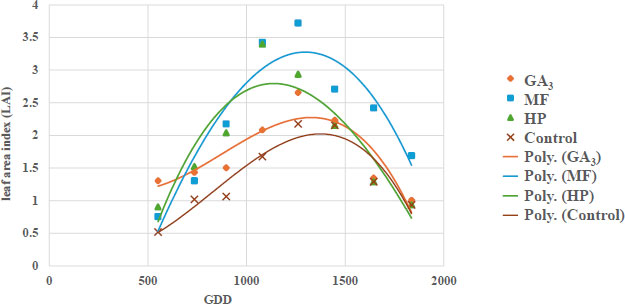
Dynamics of Leaf Area Index (LAI) in safflower under different seed priming treatments, MF (magnetic field), GA3 (Gibberellic Acid), HP (Hydropriming), and control, over the growing season, illustrating differences in canopy development and duration that influence light interception, biomass accumulation, and final yield.
3.3. Crop Growth Rate (CGR)
CGR increased rapidly during early growth stages and reached maximum values prior to the reproductive phase across all treatments (Fig. 3). The highest CGR values were observed under MF priming, with peak values occurring at approximately 1250 GDD. Compared with MF, CGR peaks occurred earlier under HP (900 GDD) and GA3 and control treatments (approximately 1000 GDD), but with lower magnitudes. MF treatment maintained higher CGR over a longer duration, which resulted in greater biomass accumulation than the other treatments.
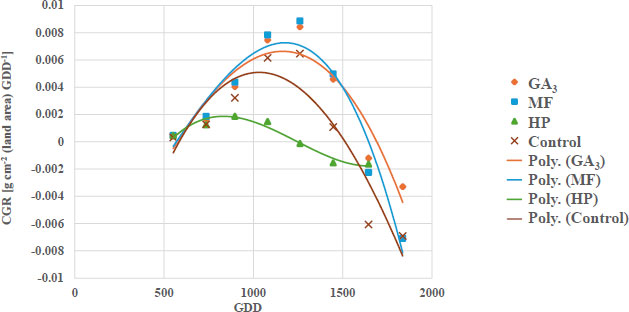
Changes in crop growth rate (CGR) of safflower under different seed priming treatments, MF (Magnetic Field), GA3 (Gibberellic Acid), HP (Hydro-Priming), and control, during the growing period, demonstrating variations in biomass accumulation rates and their contribution to overall plant productivity.
3.4. Relative Growth Rate (RGR)
RGR was highest during early growth stages and declined progressively with plant age in all treatments (Fig. 4). Although HP treatment exhibited slightly higher RGR during early stages, this effect was observed only during the early growth stages. MF and GA3 treatments maintained relatively higher RGR during later growth stages compared with HP and control, which contributed to greater cumulative biomass production.
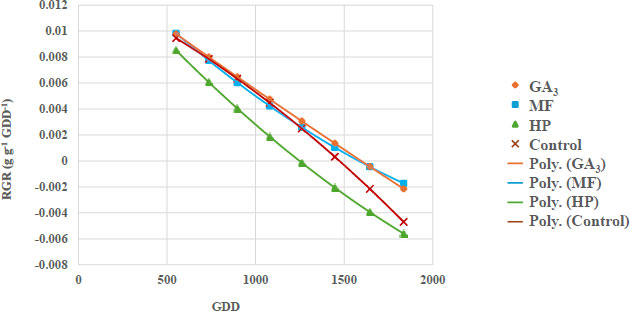
Relative Growth Rate (RGR) of safflower plants as influenced by seed priming treatments, MF (Magnetic Field), GA3 (Gibberellic Acid), HP (Hydro-Priming), and control, during the growing season, indicating differences in growth efficiency and biomass accumulation relative to plant size.
3.5. Net Assimilation Rate (NAR)
NAR varied among treatments and growth stages (Fig. 5). GA3 treatment showed the highest peak NAR values, indicating higher photosynthetic efficiency per unit leaf area. However, MF-treated plants maintained more stable NAR values during critical growth stages, which, combined with higher LAI and LAD, was related to greater overall biomass accumulation and yield.
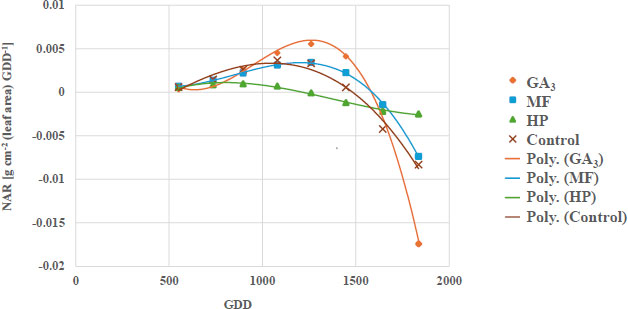
Variation in Net Assimilation Rate (NAR), representing photosynthetic efficiency per unit leaf area, of safflower under different seed priming treatments, MF (Magnetic Field), GA3 (Gibberellic Acid), HP (Hydro-Priming), and control, throughout the growing period, reflecting differences in photosynthetic performance and resource use efficiency.
3.6. Total Dry Matter (TDM)
Total dry matter accumulation increased steadily throughout the growing season across all treatments (Fig. 6). MF treatment showed significantly greater TDM compared with GA3, HP, and control treatments (P < 0.01). At final harvest, MF-treated plants exhibited the greatest biomass accumulation, consistent with higher CGR and sustained canopy development. GA3 and HP treatments also improved TDM relative to the control, but their effects were smaller than those observed under MF treatment.
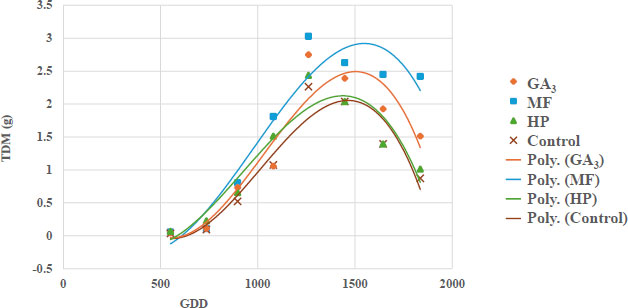
Total Dry Matter (TDM) accumulation in safflower plants subjected to different seed priming treatments, MF (magnetic field), GA3 (Gibberellic Acid), HP (Hydro-Priming), and control, over the growing season, illustrating cumulative biomass production and its relationship with treatment-induced growth responses.
3.7. Correlation Analysis
The relationship between seed yield and canopy development parameters, particularly LAImax and LAD, is presented in Figs. (7 and 8). Seed yield showed a positive association with LAImax and LAD, indicating that greater canopy development and canopy persistence were accompanied by higher yield levels across treatments. Because these relationships were evaluated using treatment means, they should be interpreted as descriptive rather than inferential statistical evidence.
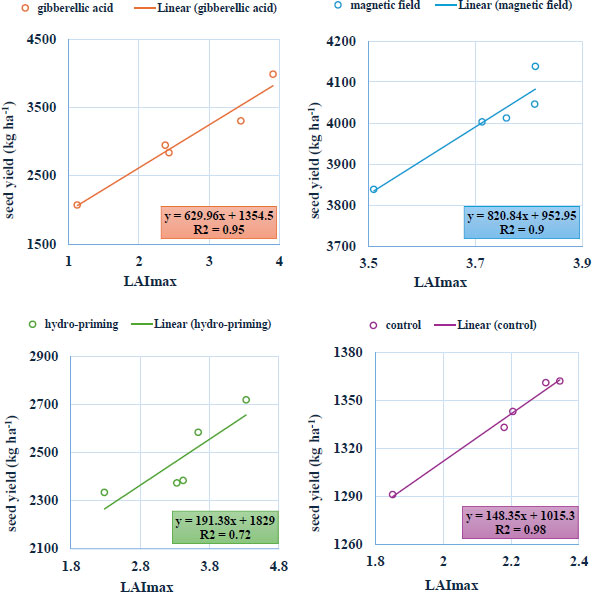
Relationship between maximum Leaf Area Index (LAImax) and seed yield (kg ha-1) of safflower under different seed priming treatments, magnetic field, gibberellic acid, hydro-priming, and control, showing the positive association between canopy development and yield formation. Each point represents a treatment mean (n = 5).
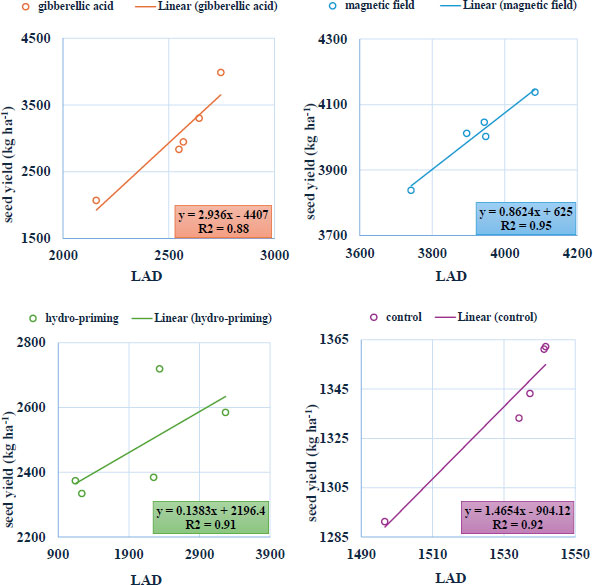
Relationship between Leaf Area Duration (LAD) and seed yield (kg ha-1) of safflower under different seed priming treatments, magnetic field, gibberellic acid, hydro-priming, and control, highlighting the importance of sustained canopy duration in enhancing yield. Each point represents a treatment mean (n = 5).
4. DISCUSSION
The present study demonstrates that seed priming significantly improves growth dynamics and yield performance in safflower, with MF priming showing the most consistent effects across growth stages. The superior performance of MF-treated plants, particularly in terms of LAImax, LAD, and total dry matter, highlights the important role of sustained canopy development in yield formation. Similar relationships between canopy persistence and yield have been reported in oilseed crops, where prolonged photosynthetically active leaf area enhances radiation interception and biomass production [39, 40]. The yield component results used in this study were consistent with previously reported findings [24]; however, the present study extends these results by integrating them with detailed physiological growth analysis to effectively elucidate the mechanisms underlying yield formation. The results suggest that the effects of MF priming may extend beyond early growth stages and may also help maintain canopy activity for a longer period, contributing to improved biomass accumulation and yield formation under field conditions [38-40].
A key contribution of this study is the comparative evaluation of MF priming alongside HP and GA3 under field conditions. While GA3 and HP improved early growth and establishment, their effects were less sustained compared with MF treatment. GA3 is known to stimulate germination and early metabolic activity through the activation of hydrolytic enzymes [21], whereas HP enhances seed hydration and early vigor [22, 41]. However, these treatments showed less influence on later-stage canopy persistence and biomass accumulation.
This pattern is generally consistent with previous reports, where improvements associated with hydropriming and hormone treatments are often more pronounced during germination and early seedling growth [21, 22]. In contrast, MF priming was associated with improved plant performance throughout the growth cycle. Similar findings have been reported in oilseed crops such as sunflower, where magnetic field exposure enhanced growth, biomass accumulation, and yield under different environmental conditions [42]. Moreover, other studies [27, 28] indicate that magnetic field priming may influence physiological processes related to photosynthesis and plant growth. These findings support the potential use of MF priming as a non-chemical method for improving crop productivity.
Although direct comparisons among studies are limited due to differences in experimental conditions and treatment protocols, previous studies have reported beneficial effects of seed priming on seed yield, supporting the potential role of magnetic field priming in improving plant growth and productivity [27, 28, 42].
The positive relationships observed between seed yield and canopy-related traits (LAImax and LAD) further emphasize the importance of canopy structure and duration in determining yield. These results suggest that treatments promoting sustained leaf area development are more effective than those mainly improving early growth stages. Similar associations have been reported in safflower and other crops, highlighting the role of canopy dynamics in yield formation [40].
Although several mechanisms have been proposed to explain plant responses to magnetic fields, including changes in membrane permeability, ion transport, and enzyme activity [28, 29], these mechanisms remain largely hypothetical and were not directly investigated in the present study. Therefore, the observed improvements should be interpreted cautiously as physiological responses rather than mechanistically confirmed processes. Accordingly, the present findings should be considered as field-level evidence of improved plant performance rather than direct confirmation of specific physiological mechanisms, and additional studies are needed to clarify the biochemical and molecular basis of these responses [28, 29].
From an agronomic perspective, magnetic field priming offers several advantages compared with conventional chemical treatments. It is a non-chemical, environmentally friendly technique that does not leave harmful residues in soil or water systems. Moreover, the ability of magnetic field priming to improve plant growth under stress conditions such as drought and salinity makes it particularly relevant for sustainable crop production in arid and semi-arid regions [10]. Similar improvements in physiological parameters following magnetic field exposure have been reported in other crops, including sunflower, bean, pea, and several medicinal plants [11, 12].
However, the practical adoption of MF priming at farm scale may depend on factors such as the availability of appropriate equipment, ease of application, and consistency of responses under different environmental conditions, particularly in comparison with simpler techniques such as hydropriming. Overall, this study provides field-based evidence that magnetic field priming enhances safflower productivity primarily through improved canopy development and sustained biomass accumulation. These findings contribute to the growing body of research on physical seed treatments and support their potential role in sustainable agricultural systems. Although the results clearly showed positive effects of seed priming, particularly under magnetic field treatment, further studies across different environments and growing seasons are needed to confirm the consistency of these responses.
5. STUDY LIMITATIONS
This study has several limitations that should be acknowledged. First, the experiment was conducted at a single location and during one growing season; therefore, the consistency of the observed responses across different environments and years remains uncertain. Second, although physiological growth indices provided valuable insights into plant performance, the underlying biochemical and molecular mechanisms of magnetic field priming were not directly investigated. Third, the study did not include an economic assessment of the feasibility of magnetic field priming under farm-scale conditions. Future research should address these limitations by conducting multi-location and multi-season trials and integrating physiological, molecular, and economic analyses.
CONCLUSION
This study shows that seed priming improves growth dynamics and yield performance of safflower (Carthamus tinctorius L.), with Magnetic Field (MF) priming producing the strongest and most consistent responses among the tested treatments. MF-primed plants exhibited higher leaf area index, longer leaf area duration, greater total dry matter accumulation, and higher seed yield compared with Hydropriming (HP), Gibberellic Acid (GA3), and the untreated control. The strong positive relationships between seed yield and canopy-related traits indicate that sustained canopy development played a key role in yield formation. Compared with HP and GA3, MF priming resulted in more persistent improvements throughout the crop growth cycle. These findings suggest that MF priming could be considered as a useful non-chemical seed treatment approach for safflower under similar field conditions. However, the results should be interpreted within the scope of the present study, which was conducted at a single location, during one growing season, and on one cultivar, and did not include direct evaluation of biochemical mechanisms or economic feasibility. From a practical perspective, MF priming represents a simple physical treatment that could complement existing seed enhancement methods. However, its large-scale applicability and performance under variable environmental conditions remain uncertain.
Future research should focus on evaluating the performance of magnetic field priming under diverse agroecological conditions, including drought, salinity, and heat stress scenarios, to better define its stability and agronomic relevance. In addition, integrating MF priming with emerging precision agriculture tools and seed technology platforms may further improve its practical use under field conditions. Economic feasibility assessments and mechanistic studies at physiological, biochemical, and molecular levels are also required to support its adoption as a sustainable alternative to conventional seed treatments. The findings of this study indicate that magnetic field priming may serve as an environmentally friendly approach for improving safflower production under similar conditions.
AUTHORS’ CONTRIBUTIONS
The authors confirm their contribution to the paper as follows: F.F., M.H.: Writing – review and editing, writing – original draft, project administration, methodology, formal analysis, data curation, conceptualization. All authors reviewed the results and approved the final version of the manuscript.
LIST OF ABBREVIATIONS
| C | = Control |
| CGR | = Crop Growth Rate |
| GA3 | = Gibberellic Acid |
| GDD | = Growing Degree Days |
| HP | = Hydro Priming |
| LAD | = leaf area duration |
| LAI | = Leaf Area Index |
| LAImax | = Maximum Leaf Area Index |
| LAR | = Leaf Area Ratio |
| MF | = Magnetic Field |
| NAR | = Net Assimilation Rate |
| RGR | = Relative Growth Rate |
| TDM | = Total Dry Matter |
AVAILABILITY OF DATA AND MATERIALS
The data that supports the findings of this study are available from the corresponding author [M.H], upon reasonable request.
ACKNOWLEDGMENTS
Declared none.